
Updated October 2026 by the Calm the Chaos team. We refreshed these ideas and the free printable.
When a child gets angry, frustrated or overwhelmed you can try to talk to them, but the words just seem to bounce right off of them with no effect.
For my special needs preschooler, this is a daily, and sometimes hourly, occurrence.
To deal with it, rather than get angry and frustrated myself, I’ve come up with 15 ways to calm an anxious child when words don’t work.

*This post may contain affiliate links. Please see disclosure for details.
Please remember, every child is different and some solutions will work for one, but not for another. My hope is to give you some ideas for calming kids when words aren’t having any effect.
If an idea doesn’t work try something else, but keep it in mind to try again later. In different situations children can respond positively to different methods.
Start With Your Own Calm
From the Calm the Chaos team: Before you try any of these, stop. Take one slow breath and plant your feet. Your calm is the most important tool in this post.
15 Ways to Calm a Child Down Without Words
1. Offer a bear hug
Open your arms and let them come to you. They set how tight.
2. Redirect
Redirect to a favorite activity or object. Be careful not to make this into a reward. Just calmly point out something that the child enjoys.
3. Whisper
Not necessarily about the situation. Speaking in a whisper can get the child to calm down so that they can hear what you are saying.
4. Sing it
Turn the situation upside down by performing your own private musical. This is an absolute favorite at our house. Sing with me… “What is the problem?” Try all your different voices: country, rock, opera.
5. Laugh
Laugh at something silly, or at yourself, never at their feelings. As an extra bonus, it will calm you down too!
6. Tickles
(only if the child normally enjoys them) This may seem out of place if a child is frustrated, but if you use it as a way to give them sensory input rather than “making light” of their emotions, it can work.
7. Weight
Sit and cuddle with a weighted blanket and favorite stuffed animal.
8. Happy music
Begin dancing and invite the child to join.
9. Bath time
Give the child a bath with warm water.
10. Essential oils
Diffusing essential oils such as Lavender, Chamomile, Cedarwood or Clary Sage may promote a calming atmosphere.
11. Patience
Sit down beside him and wait. Don’t say or do anything. Let him try to find his own calming mechanism. This will not work in severe cases, but it can work if you catch the situation right away.
12. Calming spot
Provide a safe place for her to calm down, never a punishment. Make sure that you stay visible and she knows she is free to leave the area.
13. Story time
Read a story. Even if the child doesn’t appear to be listening at first, provide a cozy place to sit and encourage them to join you as you read a story aloud.
14. Sensory play
Give him play dough to squeeze his hands into. This can give the child a place to focus his energy.
15. Massage
Ask first, then give her a shoulder rub or foot rub. Applying gentle pressure can help release tension.
When to Get More Help
From the Calm the Chaos team: If the anxiety shows up often, keeps getting bigger, or anyone is at risk of getting hurt, talk with your pediatrician or a therapist. You don’t have to figure this out alone.
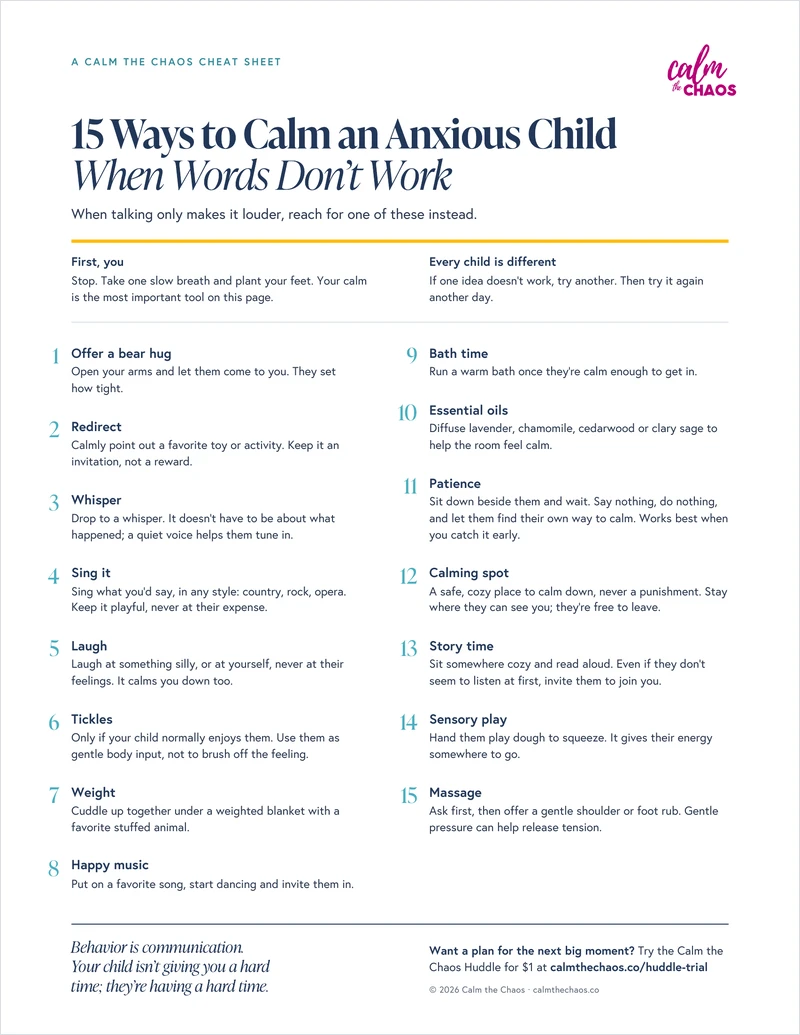
Free Printable: 15 Ways to Calm an Anxious Child When Words Don’t Work
I have made a simple printable for you that has all of these strategies in a simple and easy to display format. Place it on the fridge, in a frame or even in your child’s calm down spot so they remember them as well.
- Get the cheat sheet. Send me the printable
- Print. Any paper will do the trick, but card stock would be ideal.
- Place it on your refrigerator.

Kim is a work at home mom of four awesome daughters {12, 10, 7 year olds and a special needs 4 year old}. She is beginning her 8th year of homeschooling and, before recently returning to the States, lived overseas for 9 years. Kim shares free printables and educational activities over at Life Over C’s
These are all great to keep in mind for future reference. One thing that I do that helps is to deliberately and audibly take deep, slow breaths. You have to do it loud enough for someone to hear you, but not so loud that it’s weird. I don’t usually say anything because my daughter freaks out more if I tell her to take deep breaths with me. But if I just start doing it, she’ll start taking deeper breaths too and calm down more quickly. I’ve even done it with adults. You can say something if the person you’re trying to calm is receptive, but it works even if you don’t say anything.
My son’s therapist actually recommends firm pressure to rub arms and legs. Not pressing so hard that you might hurt the child, but not a light touch either.
Hi, all your suggestions are good, but I’m not to fond of the tickle of any sort. I’m a survivor of childhood sexual abuse and tickling was a former of torture to me. I never tickle my children even if they liked it. I just believe that you just don’t know if a child thinks it fun because they are laughing or painful. I just feel you should never tickle a child at all.
My son on the other hand loves tickles and actually asks for them. Sad your experiences weren’t so good you do what is comfortable and what works
for you
Patience is probably what we use most at our house. Our son goes from zero to sixty in less than 5 seconds it seems. And different things work on different days, depending on his moods as well. Thank you for sharing. I really appreciate it. 🙂
Great list but tickling actually makes them feel even more out of control and powerless, according to Dr Laura Markham. While the child laughs and appears to enjoy it, this is actually an overpowering sort of play and the reflex is to laugh, its not always a happy laugh like we assume it is. When you think about it, the adult is completely in control and the child loses the ability to stand up for herself. Many kids end up out of breath, begging for the parent to stop tickling, she says. Rough housing style play, on the other hand, is fun and is a great outlet for them without losing any power. She says kids often initiate tickling as its a way to be physically connected to us but actually when you initiate other physical games with your children, they are less likely to ask for tickles and prefer the other types of physical play instead. Just thought it was interesting and worth mentioning! 🙂
I am Nana to my wonderful three year old grandchild Lincoln. The age of 3 1/2 has been a bit challenging so I was so grateful to find this for help. things are so much better the ways children are raised compared to when I was a child.
My ASD son age 9 arrives directly from his Dads it takes 30-45 mins sometimes the remainder of the day to adjust. He is upset and i have to leave the room. He doesn.t want me near him. Last time he was crying and wanted to be alone. He can get aggressive and also doesn’t say kind words toward me. I’ve tried to stand back and let him adjust in his own time, but dont want to be too remote that I’m not interested in him or what he has done at School etc. I now put the tv on for him so that he can adjust without any issues but Im also worried that this will continue if I dont get help for him.